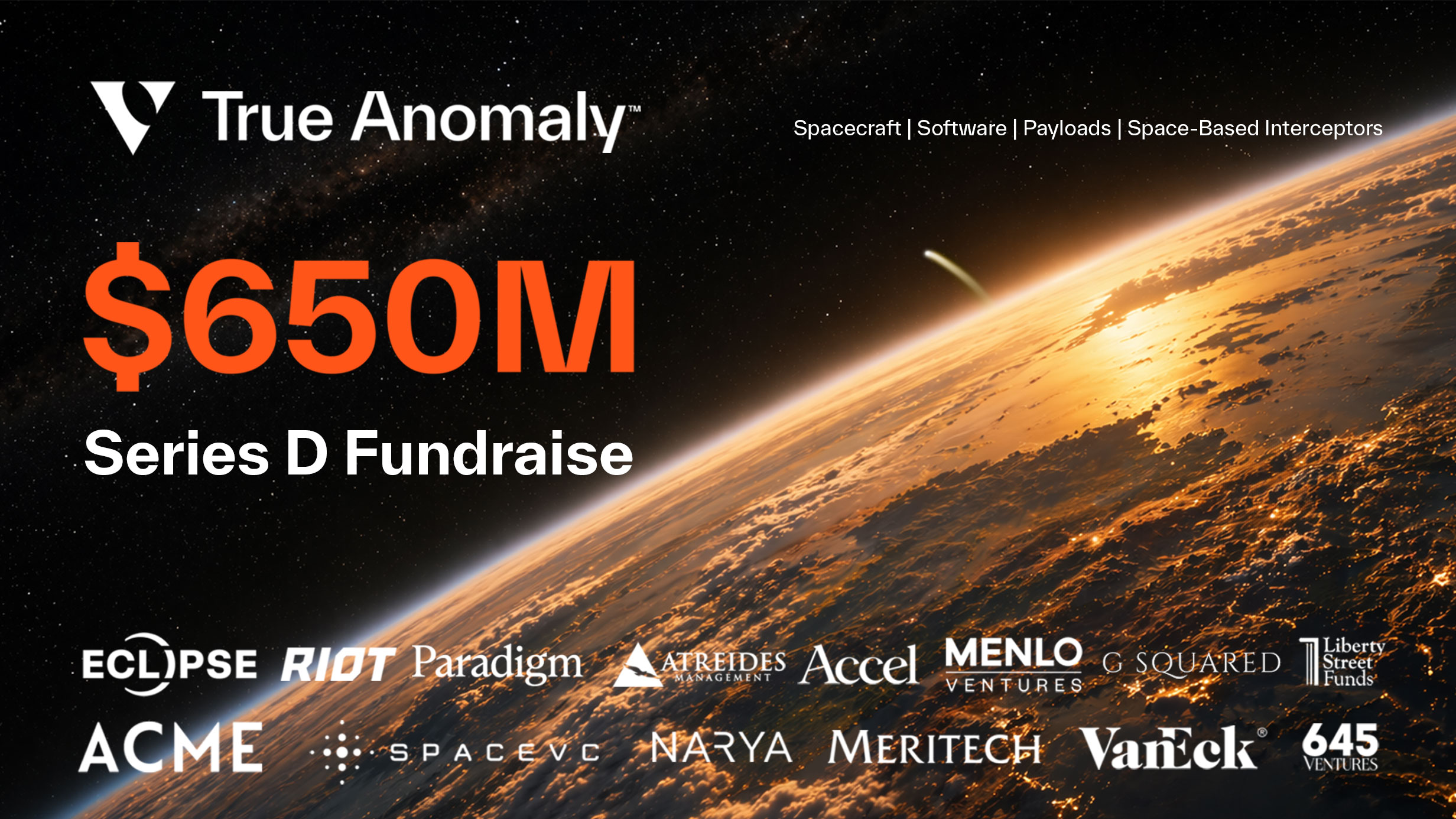
Today, we are announcing our $650 million Series D financing, surpassing $1 billion in total capital raised since our 2022 founding. This milestone reflects both the momentum we have built in four short years and the urgency of the moment the United States and its Allies face in ensuring freedom of action in space. The window for the U.S. and its Allies to establish space superiority is open, but it is narrowing rapidly.
The round was co-led by Eclipse and Riot Ventures, with support from new investors Paradigm, Atreides, G Squared, The Private Shares Fund, VanEck, and others, alongside existing investors Accel, Menlo Ventures, ACME Capital, Space VC, Meritech Capital, Narya, and 645 Ventures. It includes $50 million in debt provided by Stifel Bank.
Recent conflicts have made clear that space superiority is not merely a conceptual imperative; it is a prerequisite for joint force success. The recent Iran conflict is the clearest contemporary example: Operation Midnight Hammer, the subsequent Iranian missile attacks, and Operation Epic Fury demonstrated how critical space-enabled intelligence, precision navigation, missile warning, communications, and electromagnetic effects are to long-range strike, force protection, and coalition decision-making. When Iran launched missiles at Al Udeid, space-based warning and tracking helped give U.S. personnel time to prepare, seek shelter, and to allocate defensive resources, demonstrating that space control can be difference between surprise and survivability.
Ukraine offers a complementary example: Both Russia and Ukraine have conducted extensive jamming, disruption, spoofing, and cyber attacks against both space systems and their services because space capabilities have proven decisive in the battlefield. Commercial operators and nation-state capabilities are both in the crosshairs, as a result. These wars prove that the force that is able to preserve friendly access to space-enabled intelligence, PNT, missile warning, communications, and electromagnetic effects—and deny them to the enemy—will hold a decisive advantage in the joint fight.
Iran and Ukraine are previews of the pacing and most dangerous threats. Against China or Russia directly, the requirement for space superiority expands to defending, reconstituting, and maneuvering a global space architecture under sustained attack by a peer adversary, while denying space capabilities to that adversary. Space superiority matters now because China and Russia have turned space from a sanctuary into a contested warfighting domain over the last twenty years, beginning in earnest with China’s 2007 direct-ascent anti-satellite test and accelerating into operational capabilities designed to hold U.S. and allied forces at risk.
China now has more than 1,300 satellites on orbit, including 510-plus ISR-capable systems, giving the PLA a rapidly expanding ability to find, fix, track, target, and strike U.S. carriers, expeditionary forces, and air wings. At the same time, Beijing is fielding counterspace tools across the kill chain: direct-ascent ASAT weapons, co-orbital “inspection and repair” satellites that can double as weapons, ground-based lasers, GPS and SATCOM jammers, maneuvering systems in GEO, and conventional space to ground weapons for unwarned global terrestrial strike.
Russia has already demonstrated destructive ASAT capability, deployed lasers and probable orbital ASAT prototypes, used cyberattacks against commercial space systems in war, and continues GPS and SATCOM electronic attacks across Europe. Finally, there is significant concern that Russia may deploy orbital nuclear weapons designed to destroy proliferated constellations. The threat is no longer theoretical or episodic; it is persistent, operational, and aimed directly at the space-enabled command, control, intelligence, targeting, navigation, and timing that make U.S. and allied military power work.
While the threat is significant, American industrial power is being unlocked by generational acquisition reform, enabling new defense companies like True Anomaly to compete on the basis of performance, rather than entrenchment. Speed to capability is now the strategic mandate, prioritizing commercial buying, firm-fixed price long-term contracts, direct-to-supplier engagement, and portfolio-based acquisition focused on mission outcomes and kill chains, not building to pre-set requirements on decade-long timelines.
It is with this backdrop that True Anomaly announces this most recent round of fundraising.
We are fortunate to have capital partners that share our vision and are committed to the singular mission of delivering decisive capabilities for space superiority.
Over the past four years, we’ve designed and are delivering Jackal, our autonomous orbital vehicle; Mosaic, our mission autonomy software platform; and an advanced payload suite spanning multiple sensing modalities across multiple programs. These are not technology demonstrations searching for a mission. They are operational products designed from the ground up for contested space, built to meet the threat at the speed and scale it demands.
Over the next 18 months, we are accelerating to deliver. We will:
• Conduct a dozen missions, including the VICTUS HAZE Tactically Responsive Space demonstration in LEO.
• Fly multiple missions and product demonstrations in LEO and GEO.
• Deliver Jackal for the U.S. Space Force's $1.8B Andromeda program, the contract underpinning the Geosynchronous Reconnaissance and Surveillance Constellation.
• Deliver Mosaic to provide the specialized software backbone for responsive tactical and operational space warfighting orchestration across multiple programs of record.
• More than double our headcount from 250 at year-end 2025 to over 500 by year-end 2026, and over 1,000 in 2028.
True Anomaly was also recently announced as a prime contractor on the U.S. Space Force Space Systems Command Space-Based Interceptor Program. Our expansion into space-based interceptors extends our portfolio into one of the most consequential national security challenges of our time, enabled by a new level of partnership between the defense industrial base and the U.S. Government. As with all our products, we are bringing together private capital, world-class talent, and industry-leading partners to execute a program with enormous national security implications.
The next phase of True Anomaly is about execution at scale: more missions, more spacecraft, more software deployed into operational environments, and a larger team built around the same purpose that has defined the company from day one. We are building for the fight that is here, the fights that are coming, and the warfighter who cannot wait.
Space warfare is entering the phase that aviation faced a century ago: doctrine, technology, and operational art are being constructed in real time, while China and Russia are fielding capabilities that leave no room for slow learning. In this moment, the product problem and the doctrine problem are one and the same. The side that can define the fight, build for it, test it, learn from it, and scale the fastest will compound advantage. True Anomaly exists to accelerate that doctrine–capability feedback loop.
That is why our portfolio — Jackal, Mosaic, advanced payloads, and space-based interceptors — is built from a clean sheet for space superiority. We did not wait for mature requirements to start building, because in a new warfighting domain, the requirements are being discovered through the act of building, operating, and learning. We combine first-hand operational experience, threat understanding, simulation, spacecraft design, autonomy, manufacturing, and flight operations to turn warfighting concepts into products the Government can buy, field, adapt, and scale.
This is also why the dual-use narrative for space is narrowing. The decisive requirements in contested space are not generic commercial capabilities with defense applications; they are purpose-built operational systems designed for maneuver, survivability, autonomy, resilience, electromagnetic conflict, and coordinated action at speed. Defense acquisition reform is creating the pathway for government to buy portfolios that deliver mission outcomes, not isolated platforms optimized for narrow specifications. True Anomaly was built for that model: direct partnership with government, mission-first design, and performance at scale.
Scale is not a feature we add later. It is a design requirement from the beginning. The legacy model of a few large, exquisite spacecraft creates targetable single points of failure and timelines too slow for the threat. The future requires more systems, fielded faster, distributed across LEO and GEO, resilient by design, and capable of being upgraded as the fight evolves. You cannot scale what you have not designed for scale, and you cannot design for scale while hedging between commercial optionality and defense necessity. True Anomaly builds exclusively for national security because the mission demands focus.
Every dollar we have raised is invested in space superiority. Every product we build is aimed at giving the warfighter freedom of action in the most consequential new battlespace of our time. We are grateful to our employees, customers, partners, and investors for sharing that conviction. The work ahead is difficult, urgent, and extraordinary: to help invent a new class of operational products, define the future of space warfare, and ensure the United States and its Allies dominate that domain for generations.

Locations
Centennial, CO
Long Beach, CA
Colorado Springs, CO
Washington, DC
Contact
For sales information, contact:
For general inquiries, contact:
True Anomaly © 2026
